Blog

  • Some UEFN Maps Grew 1,200% Last Week. Here’s What They Have in Common.

    Some UEFN Maps Grew 1,200% Last Week. Here’s What They Have in Common.

    Right now, a handful of Fortnite Creative maps are exploding. Not gradually, but 400%, 600%, even 1,200% week-over-week growth.

    See the live growth data on visceral.io

    Most creators never see this. They’re watching their own CCU in isolation with no idea what’s actually moving on the platform.

    Here’s what the data shows:

    The fastest-growing maps aren’t the biggest ones. Battle Royale dominates raw playtime — by a mile. But the maps with the highest week-over-week growth right now are smaller, newer titles: steal formats, gun game variants, tycoons. They don’t have massive audiences. They found the right moment.

    Genre share and growth rate are two different things. “Just for Fun” owns 10.9% of all Fortnite Creative players — the largest single genre. But the maps growing fastest this week aren’t all sitting in dominant genres. That gap between genre popularity and growth velocity is exactly where opportunity lives.

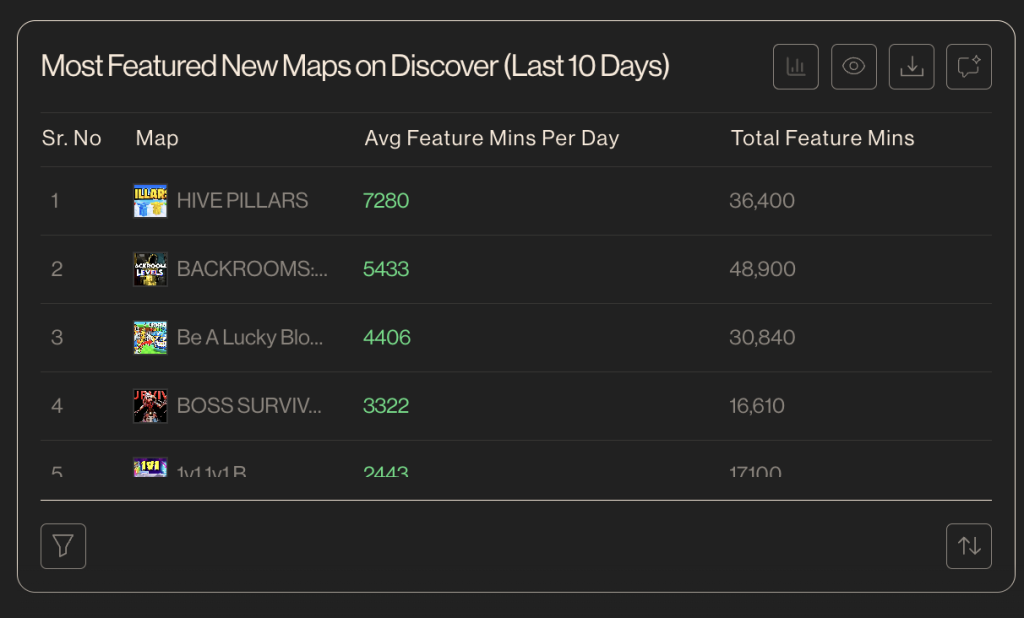
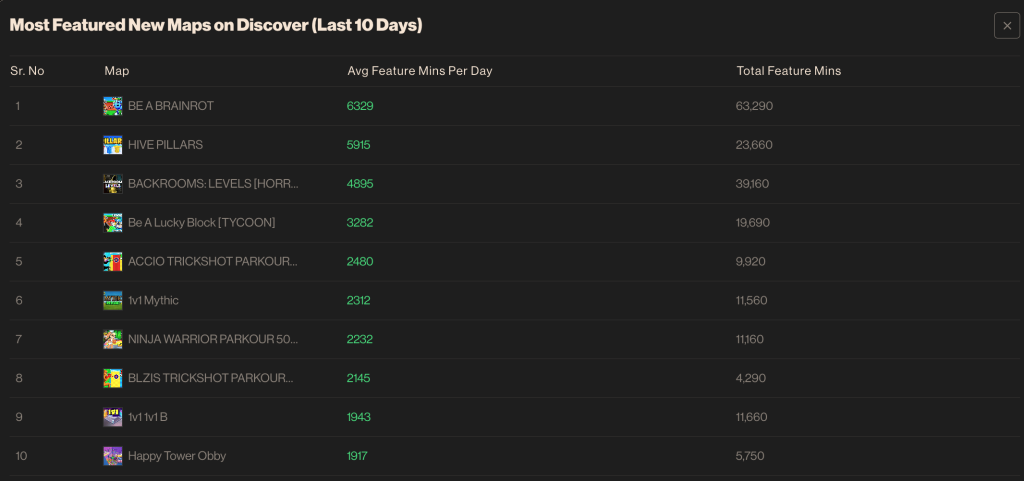
    Discover feature time is the real multiplier. The most-featured new map on Discover over the last 10 days averaged 2,320 feature minutes per day. The #5 map averaged 1,015. Both are “featured” — but one is getting more than double the exposure. Knowing where your map sits in that window, and why, is the difference between a normal week and a breakout week.

    The takeaway The maps growing 1,200% week-over-week aren’t necessarily better than yours. They’re better timed, better positioned, or better understood by their creators.

    visceral.io tracks week-over-week growth, genre benchmarks, and Discover feature performance across the entire platform — so you can see exactly where your map stands against what’s actually blowing up right now.

    Explore the data yourself, the Visceral.io

  • Your Map Has 7 Days, But Not For the Reason You Think

    Your Map Has 7 Days, But Not For the Reason You Think

    Most Fortnite creators have heard some version of this warning: you have 7 days before the algorithm forgets you. Publish, spike, fade. That’s the assumed arc.

    The data tells a more interesting story.

    The First Week Is a Filter, Not a Finish Line

    Looking at featured map performance across the last 30 days, maps in their first 7 days average just 9.36 peak CCU. That sounds brutal — and for most maps, it is. But the maps that survive that window?

    They see a 440% jump in peak CCU in the following three weeks, averaging 50.55 by the 8–30 day mark.

    And the maps that make it past 30 days? They average 2,691 peak CCU — nearly 300x the week-one average — with over 3,100 average feature appearances.

    This isn’t a decay curve. It’s a funnel.

    The Survival Bias Effect

    Here’s why the numbers look the way they do: underperforming maps don’t stay in the featured rotation. They get abandoned by their creators, or deprioritised by the algorithm. What remains in the 8–30 day cohort is a self-selected group of maps that earned their place.

    In other words, the 440% growth isn’t magic. It’s what happens when only the sticky maps survive.

    The question isn’t “will my map last past 7 days?” The real question is: what does it take to be one of the maps that does?

    What the First Week Is Actually Measuring

    During launch, new maps enter a discovery spike — higher impressions, more experimental clicks, volatile retention. The algorithm is essentially testing your map on cold audiences.

    What it’s watching for isn’t raw CCU. Based on the data from Visceral’s featured map analysis, the metric that correlates most with sustained featuring is feature minutes — the total playtime your map generates while it’s in the discovery rotation.

    Maps that kept players longer got featured longer. And longer featuring creates more impressions, more players, more playtime. The feedback loop is self-reinforcing.

    This means the first 7 days isn’t about getting the highest spike. It’s about proving your map is worth keeping.

    The Chapter Launch Window: When the Door Opens Wide

    Chapter launches are a special case. During the Chapter 7, Season 2 launch weekend, 143 new maps entered the Fortnite Top 100 across three days — roughly 40–58 new entries per day.

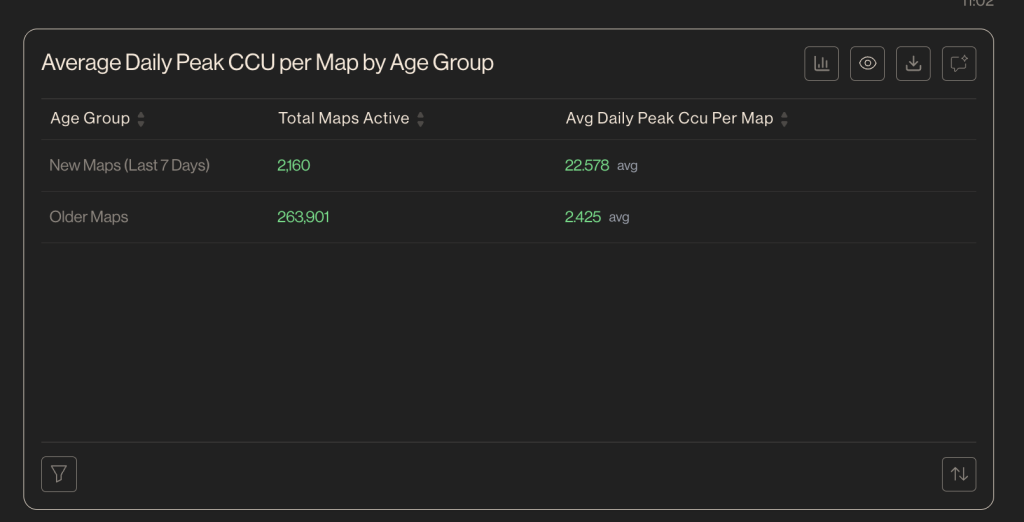
    New maps (under 7 days old) averaged 22.58 peak CCU during that period. Older maps averaged just 2.43. That’s an 89% engagement advantage for being new during a launch window.

    The discovery window isn’t fixed. Chapter launches, seasonal events, and algorithm shifts can expand it significantly. Creators who understand this can time their launches to coincide with moments when the platform is actively surfacing new content.

    Which Genres Survive Longest

    Not all maps age the same way. Looking at which genres generate the most sustained feature appearances, two patterns emerge.

    High-action genres like Simulator (~1,143 avg peak CCU) and Tycoon (~898 avg peak CCU) lead on raw player numbers. But niche categories like Choices Matter and Card Game stay featured 2–3x longer, averaging over 1,746 feature appearances. These genres have lower player volume but dramatically higher loyalty — players return, fatigue is low, and the algorithm keeps rewarding them.

    The takeaway: peak CCU and feature longevity aren’t the same thing. A smaller, deeply loyal audience can outlast a bigger, more casual one.

    What This Means for Creators

    If the first 7 days is a filter, your job during that window is to pass it. That means:

    Optimise for retention, not launch noise. A Day-1 spike that doesn’t convert to Day-2 play hurts your standing with the algorithm. Early retention signals are what extend your featuring window.

    Build for short loops, not long setups. The maps that pass the filter share a pattern: fast onboarding, repeatable gameplay, and sessions that players choose to extend — not ones they endure.

    Time your launch deliberately. Chapter launches, season starts, and event windows dramatically increase the volume of new maps getting surfaced. A strong map launched at the right moment gets substantially more discovery exposure than the same map launched on a quiet Tuesday.

    Don’t read week one as the final verdict. Maps at 9.36 average CCU in week one don’t look like hits. The ones that earned their way to 50+ by week four didn’t look like hits either — until they were.

    The Takeaway

    The 7-day window is real. But it’s not a deadline. It’s a test.

    The Fortnite algorithm is asking a simple question in those first seven days: do players come back? Maps that answer yes don’t fade. They compound.

    Your map’s first week isn’t about going viral. It’s about proving it’s worth keeping around.

    Want insights like this for your own map?

    Ask the Visceral AI chatbot anything. From retention benchmarks to Discover performance.
    Stop guessing and start optimizing with real Fortnite data.
  • Brainrot Maps Are Exploding And It’s Not Random

    Brainrot Maps Are Exploding And It’s Not Random

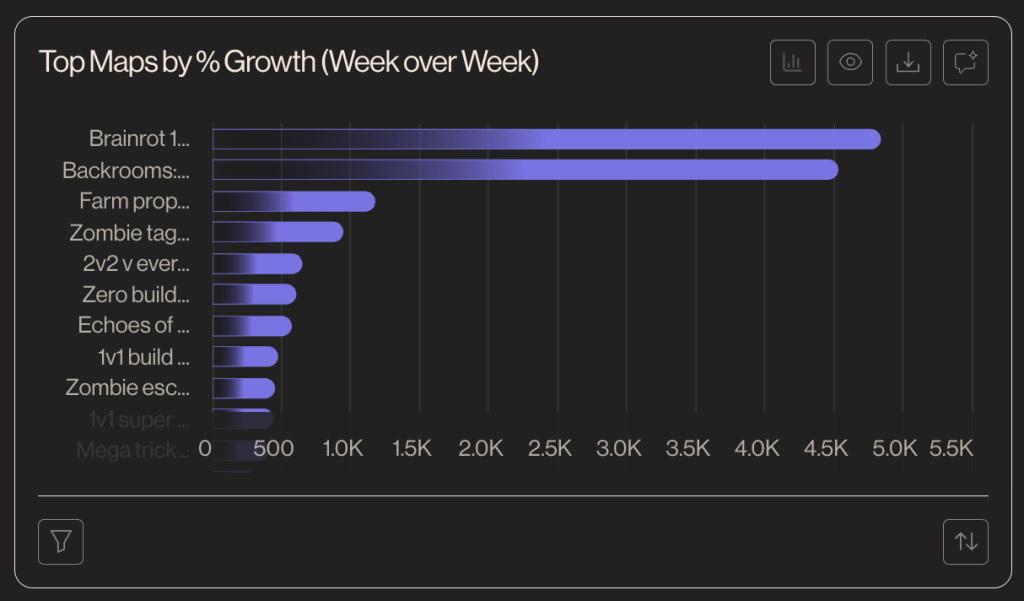
    One trend is quietly dominating Fortnite Discover right now: Brainrot-style maps are growing faster than everything else.

    Looking at week-over-week growth, Brainrot leads by a huge margin — significantly outperforming even established formats like Backrooms, Zombie, and 1v1 maps.

    The gap isn’t small.
    Brainrot maps show multiple-thousand percent growth, while most other genres cluster far behind.

    This isn’t just a one-off spike either.

    At the same time, Brainrot-style experiences are also appearing in top featured maps, and generating some of the highest feature minutes per day, meaning they aren’t just getting clicks — they’re holding players.

    This combination matters:

    • High growth
    • Strong featuring
    • Sustained playtime

    That’s usually the recipe for Discover momentum.

    Why This Format Works

    Brainrot maps typically share a few characteristics:

    • Fast loops
    • Chaotic progression
    • Meme-driven mechanics
    • Low friction onboarding
    • High replayability

    In other words, they maximize engagement density, which Discover appears to reward.

    What This Means for Creators

    You don’t need to build a Brainrot map — but you should understand what’s working:

    • Short cycles outperform long setups
    • Humor increases replayability
    • Low commitment boosts session starts
    • Chaos often beats polish

    Right now, engagement-first design is winning, and Brainrot just happens to embody it.

    The Takeaway

    Brainrot isn’t just a meme.
    It’s a signal.

    And the signal is clear:
    Discover currently rewards fast, replayable, high-energy experiences.

    Want insights like this for your own map?

    Ask the Visceral AI chatbot anything. From retention benchmarks to Discover performance.
    Stop guessing and start optimizing with real Fortnite data.
  • What Actually Gets You Into Fortnite Discover (It’s Not CCU)

    What Actually Gets You Into Fortnite Discover (It’s Not CCU)

    Most Fortnite creators believe getting into Discover is simple:
    get high CCU, get featured.

    The data tells a different story.

    We analyzed the most featured new maps on Discover over the last 10 days, and the strongest signal wasn’t peak player count — it was how much playtime each map generated once players entered.

    In other words: Discover appears to reward engagement depth, not just player volume.

    The Metric That Stands Out: Feature Minutes

    Instead of looking at CCU, we looked at average feature minutes per day — essentially how much total playtime each featured map generated while on Discover.

    The results were clear.

    Maps that stayed featured the longest were the ones generating the most sustained playtime, not necessarily the biggest spikes.

    Discover Favours Maps That Keep Players, Not Just Attract Them

    If Discover only rewarded CCU, we’d expect short-session, high-spike maps to dominate.

    Instead, we see:

    • Obbies (obstacle courses) with repeatable runs
    • Tycoons with progression loops
    • Horror maps with exploration pacing
    • 1v1 maps with replayability

    Different genres, same pattern: they all encourage longer sessions or repeat play.

    This suggests Discover is optimizing for total engagement generated, not just traffic.

    Feature Duration Reinforces the Pattern

    Looking at total feature minutes further supports the trend:

    Maps that generated more playtime stayed featured longer — creating a feedback loop:

    More engagement → longer featuring → more impressions → more engagement.

    What This Means for Creators

    If you’re optimizing purely for clicks or launch spikes, you may be focusing on the wrong metric.

    The data suggests Discover rewards:

    • Strong early retention
    • Replayable mechanics
    • Progression systems
    • Session-extending loops
    • Low early quit rates

    Not just:

    • Big launch CCU
    • Viral moments
    • Short high-intensity gameplay

    Put simply: keeping players matters more than attracting them.

    Want insights like this for your own map?

    Ask the Visceral AI chatbot anything. From retention benchmarks to Discover performance.
    Stop guessing and start optimizing with real Fortnite data.
  • Fortnite’s Health Check: Chaotic, Spiky and Very Much Alive

    Fortnite’s Health Check: Chaotic, Spiky and Very Much Alive

    If Fortnite were a patient, the diagnosis would read: erratic pulse, strong appetite, slightly addicted to novelty. In other words perfectly healthy for a live-service game in 2026.

    The Heartbeat Is Still Strong

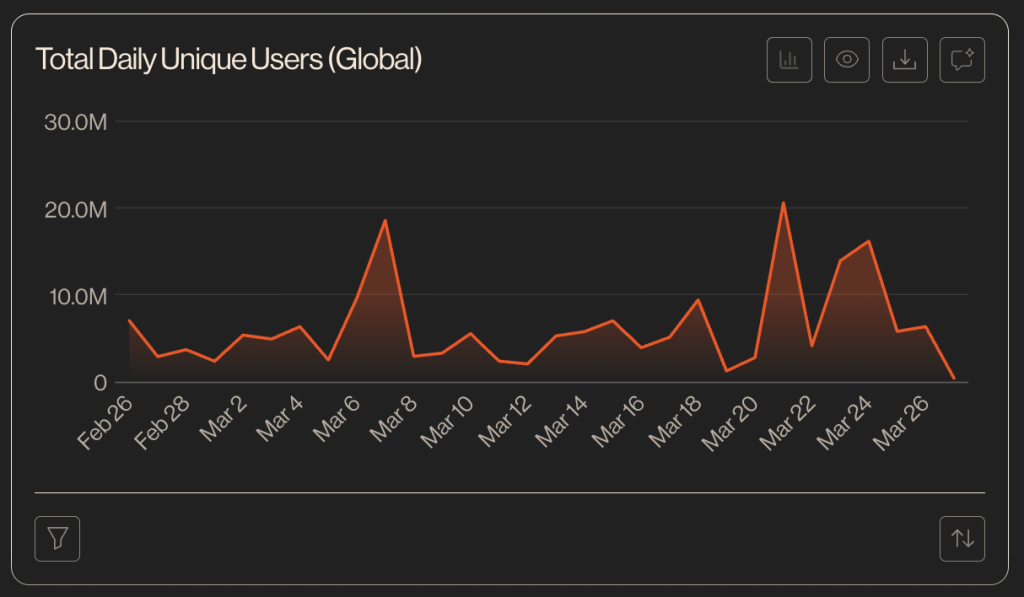
    Daily unique users swing hard. From late February through March, the data shows two major spikes, one near ~19M on March 8 and another hitting ~21M around March 22 — before dropping back to a baseline of 5–8M. That’s not decline. That’s event-driven elasticity.

    Fortnite no longer behaves like a steady multiplayer game. It behaves like TikTok. Peaks come from moments, not routine. The ceiling remains high; getting there just requires a trigger.

    Battle Royale Still Pays the Bills

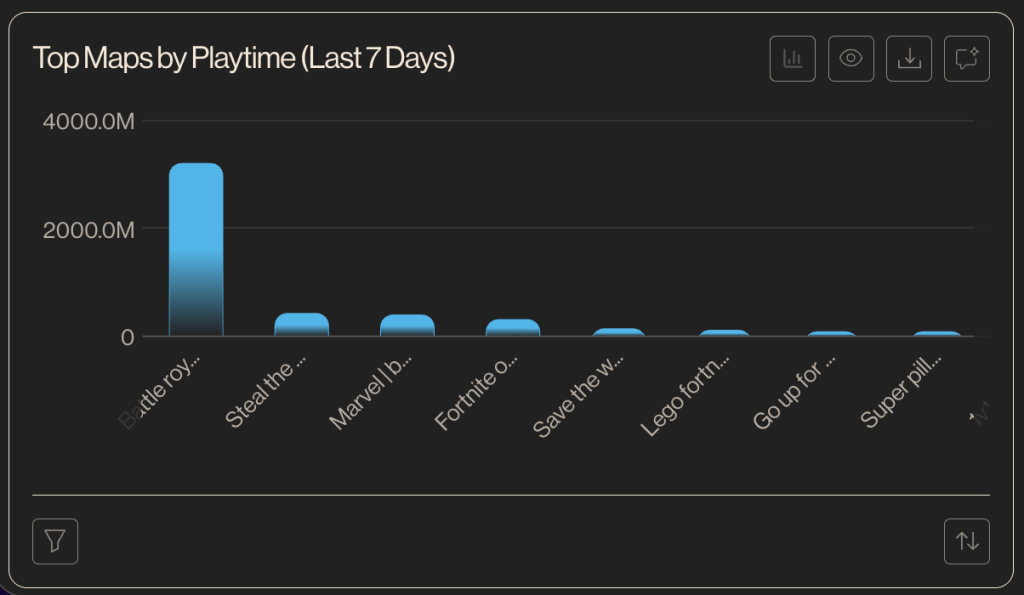
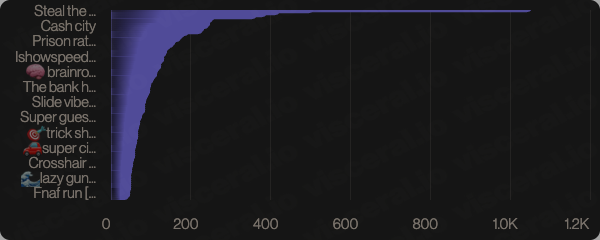
    The playtime gap is starker than most people realise. Battle Royale logged roughly 3,000M minutes in the last 7 days. The next closest, “Steal the Brainrot” sits at around 300–400M. Everything else barely registers on the same chart.

    Creative isn’t replacing BR; it’s orbiting it. The ecosystem is additive, not cannibalistic, at least for now.

    Discovery Is Powered by Spikes, Not Stability

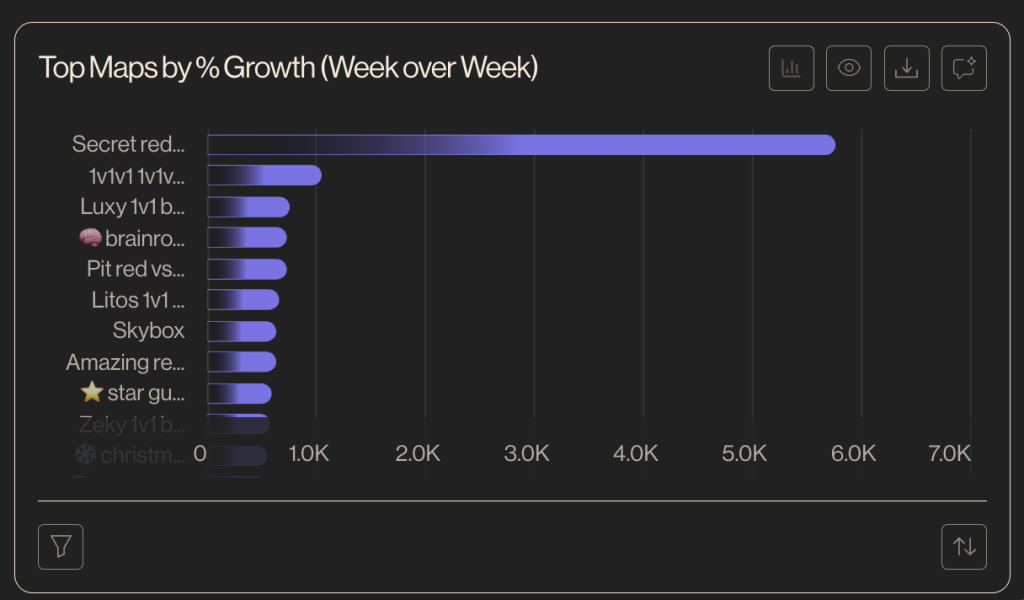
    The week-over-week growth chart makes one thing immediately clear: “Secret red vs blue” grew approximately 6,000% in a single week. The runner-up, a 1v1v1 map, came in around 1,200%. After that, growth falls sharply.

    These aren’t slow burners. They’re viral bursts. Fortnite Discover behaves more like YouTube Shorts than a traditional game store — if you don’t pop fast, you don’t pop at all.

    Engagement Shows a Winner-Takes-Most Pattern

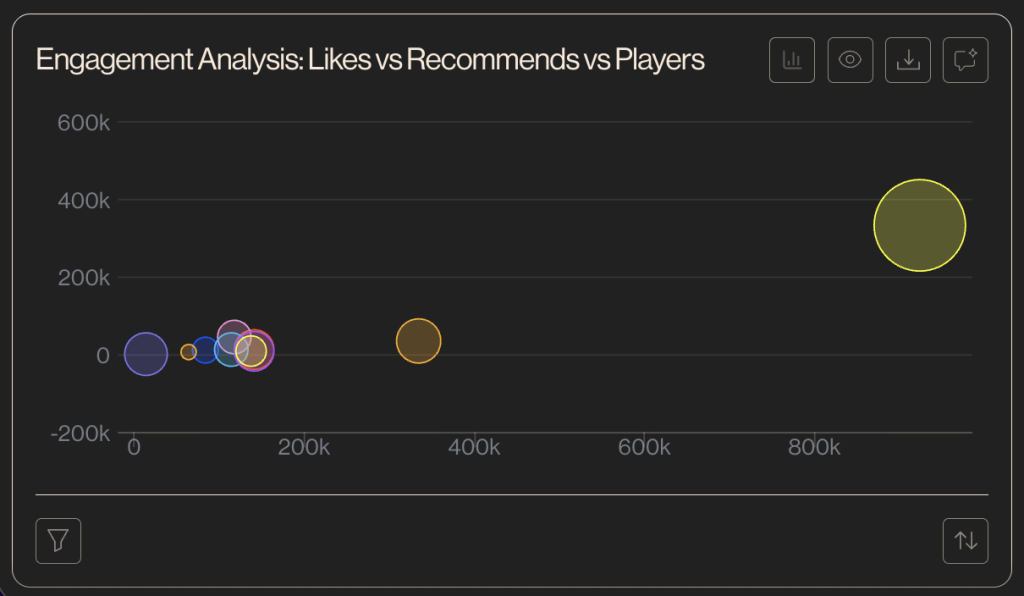
    The engagement scatter plot is almost comically lopsided. One map sits alone at roughly ~900K players with ~400K likes and recommends. Every other map clusters in the bottom-left corner, barely visible at scale.

    This is a textbook power-law distribution. Fortnite Discover isn’t crowded — it’s top-heavy. But that’s also what keeps the ecosystem exciting: a new map can still break through. It just has to break through hard.

    Genres: Chaos, Not Monoculture

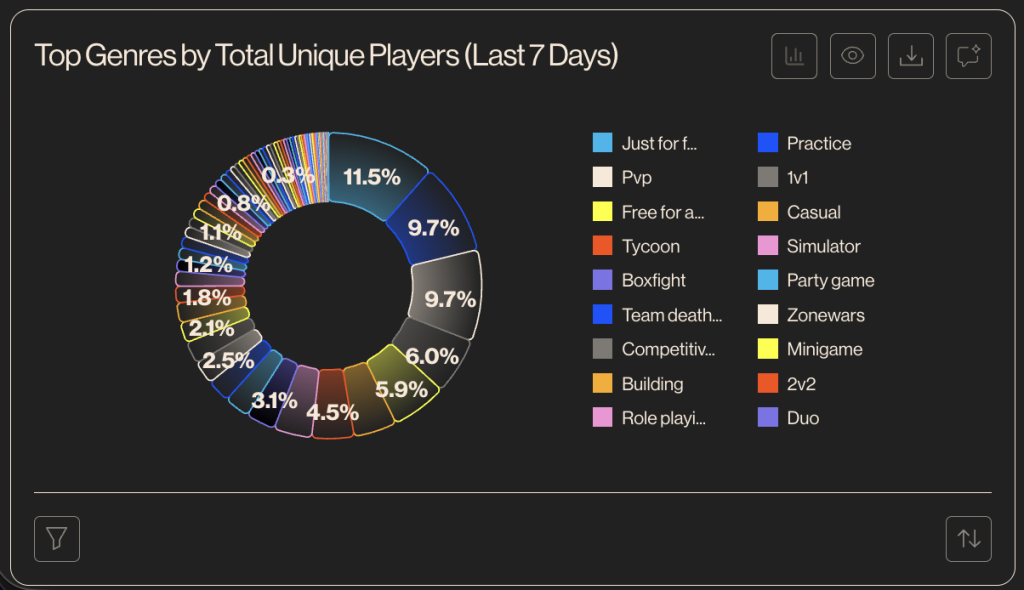
    No single Creative genre dominates. “Just for Fun” leads with 11.5% of unique players, followed by PvP and Free-for-All at 9.7% each, then Tycoon (6.0%) and Boxfight (5.9%). The long tail continues through Team Deathmatch, Competitive, Building, and Roleplay — none individually significant.

    The largest slice being just 11.5% is a bullish signal for a platform this size. Players aren’t locked into one format, experimentation still works, and trends can shift quickly. Fortnite is less “one meta” and more controlled chaos.

    Featured Maps Reinforce the Viral Loop

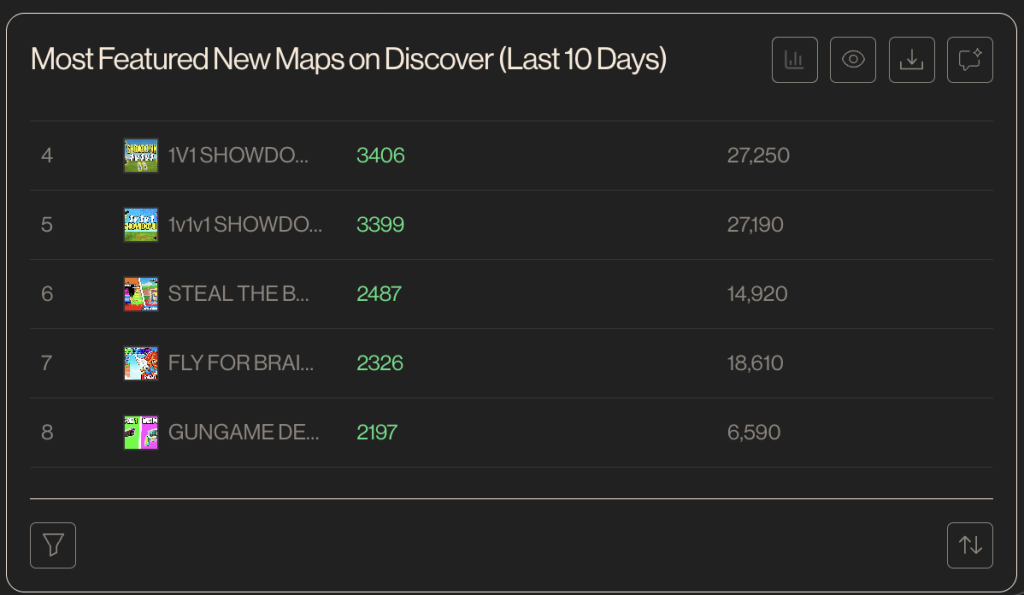
    The most-featured new maps of the last 10 days tell a consistent story: 1V1 SHOWDOWN (3,406 features, 27,250 players), 1v1v1 SHOWDOWN (3,399 features, 27,190 players), STEAL THE BRAINROT (2,487 features, 14,920 players), FLY FOR BRAINROTS (2,326 features, 18,610 players).

    Short, competitive, repeatable. Epic is promoting fast entry, instant skill expression, and quick return loops, i.e. the same design logic that keeps social platforms sticky.

    So… Is Fortnite Healthy?

    Yes, but not in the traditional sense.

    Fortnite isn’t stable. It’s elastic. It spikes, rotates trends, redistributes attention, and lets new winners emerge. That’s messy, but it’s exactly what keeps a UGC platform alive. The 6,000% week-over-week surge on a single map isn’t an anomaly, it’s the product working as designed.

    The biggest takeaway: Fortnite no longer behaves like a game with modes. It behaves like a content platform with gravity.

    Battle Royale is the sun. Creative is the weather. Discover is the algorithm.

    And right now? The forecast is volatile with a high chance of growth.

    Want insights like this for your own map?

    Ask the Visceral AI chatbot anything. From retention benchmarks to Discover performance.
    Stop guessing and start optimizing with real Fortnite data.

  • Fortnite Chapter 7, Season 2 Launch Weekend Analysis

    Fortnite Chapter 7, Season 2 Launch Weekend Analysis

    New Fortnite chapters usually reset attention. This one didn’t just reset it, it scrambled it.

    Looking at Creative data from Thursday through Sunday, three things became clear: players explored more, competitive maps stalled, and meme-driven chaos dominated.

    Casual Chaos Took Over

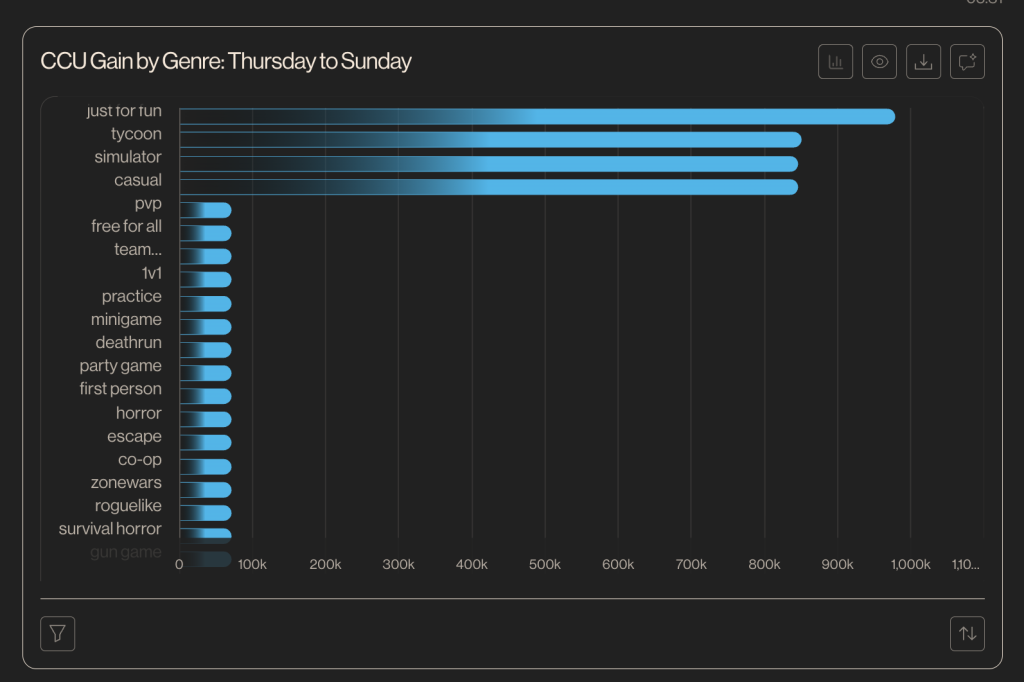
    The biggest winner wasn’t PvP, practice, or competitive formats. It was “just for fun.”

    That genre alone added ~978,000 CCU, the largest gain across the board.
    Tycoon and simulator weren’t far behind, both adding ~845K CCU, but competitive formats barely moved.

    PvP, by comparison, gained only ~53K CCU.

    That’s not a small difference – it’s a structural shift. During chapter launches, players don’t want skill expression. They want frictionless chaos.

    Brainrot Went From Trend to Dominant Strategy

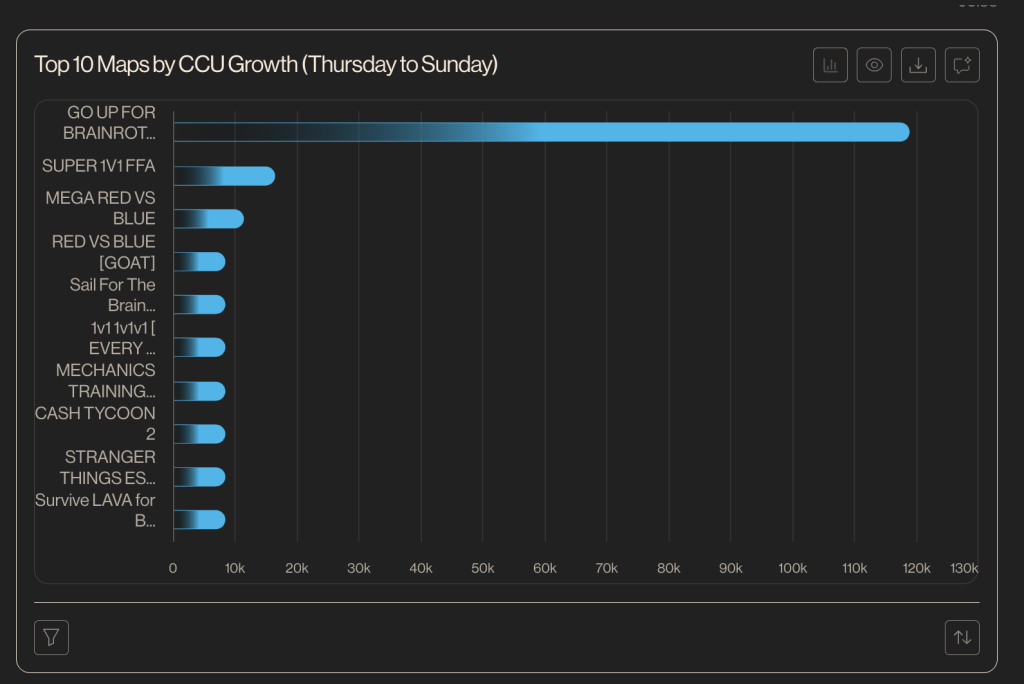
    The biggest single map growth belonged to GO UP FOR BRAINROTS, which gained 118,790 CCU – dwarfing the rest of the top 10.

    More telling: brainrot-themed maps made up 30% of the top 10 by raw growth and 60% of the top 10 by percentage growth.

    This isn’t just meme content performing well. It’s meme content defining the moment.

    Competitive staples like SUPER 1V1 FFA still grew, but in the 11–16K range, far behind the chaotic leaders.

    The Discovery Window Was Real and Brutal

    New maps (last 7 days) averaged 22.58 peak CCU, while older maps averaged just 2.43.
    That’s an ~89% engagement drop once a map ages out of the “new” window.

    Chapter launches amplify this effect. Players explore aggressively, and attention rotates quickly.

    Leaderboard churn confirms it:

    • 58 new entries on Friday
    • ~40 new entries per day across the weekend
    • 143 total new maps entering the Top 100

    In short: visibility was wide open but only briefly.

    Engagement Dipped, Then Stabilized

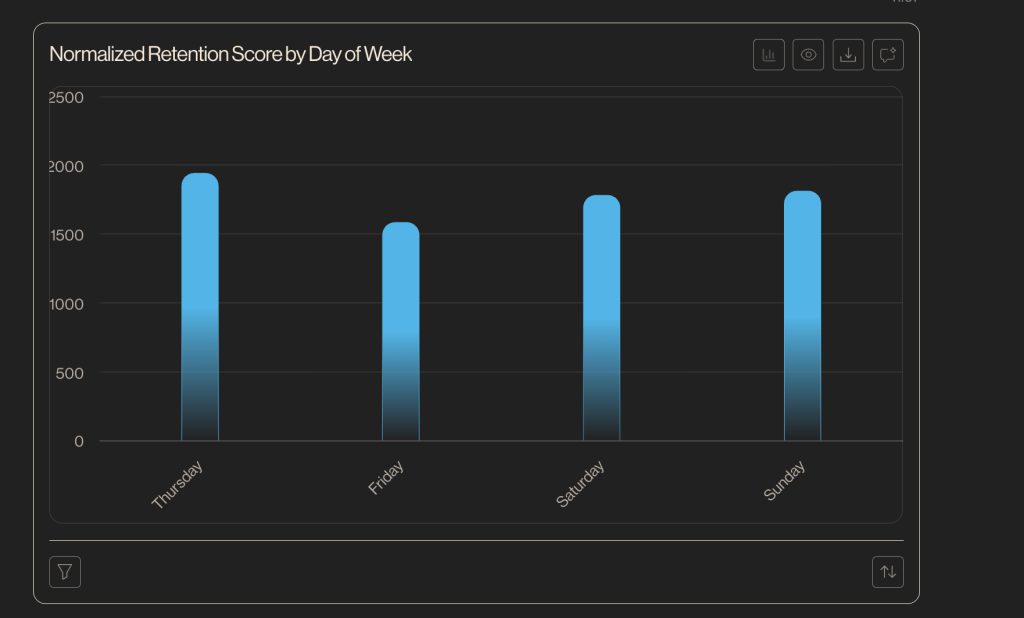
    Total Creative CCU actually fell ~67% compared to the previous four days, suggesting normalization after launch hype or broader player redistribution.

    But retention held relatively steady:

    • Thursday peak: 1,941
    • Friday dip: ~18% drop
    • Sunday recovery: 1,816

    Players didn’t stop playing, they spread out.

    What This Means

    This chapter launch didn’t reward depth. Epic reward immediacy.

    The winners shared three traits:

    • instant understanding
    • chaotic payoff loops
    • low skill barrier

    Meanwhile, competitive formats, which rely on mastery and repetition, struggled to capture exploratory traffic.

    The takeaway is simple:
    When Fortnite resets, players experiment.
    And when players experiment, chaos wins.

    This weekend, progression didn’t dominate. Skill didn’t dominate.
    Funny, fast, and slightly ridiculous did.

    Want insights like this for your own map?

    Ask the Visceral AI chatbot anything. From retention benchmarks to Discover performance.
    Stop guessing and start optimizing with real Fortnite data.
  • ‘Funny’ Is One of the Most Powerful Genres in Fortnite

    ‘Funny’ Is One of the Most Powerful Genres in Fortnite

    Fortnite Creative isn’t just trending toward bigger progression systems or deeper tycoons. The data is pointing somewhere else: humor-driven maps are quietly becoming one of the strongest retention engines in the ecosystem.

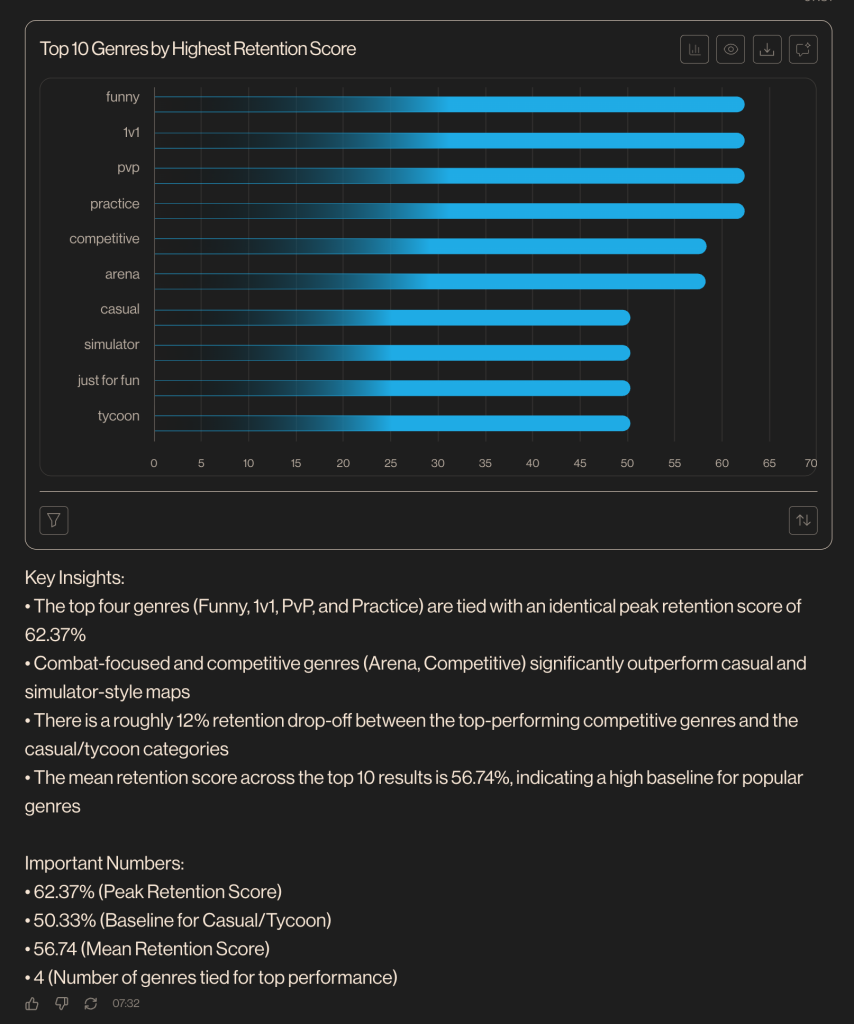
    According to Visceral data, the “Funny” genre sits at the very top of retention, tied with 1v1, PvP, and practice maps at roughly 62% retention. That puts it well above simulator, casual, and tycoon experiences, which cluster closer to the ~50% range.That’s a meaningful gap. And it suggests something important: players don’t just come for chaos — they stay for it.

    Why Funny Maps Retain So Well

    1. Instant understanding
    Funny maps usually require no onboarding. The loop is obvious within seconds — press a button, trigger something absurd, repeat. No learning curve means fewer early drop-offs, which boosts retention.

    2. Fast payoff loops
    Humor relies on timing. The best funny maps deliver reactions quickly: unexpected physics, exaggerated outcomes, or rapid resets. Short loops encourage repeat behavior and keep players engaged.

    3. Social stickiness
    Funny gameplay is inherently shareable. Players stick around to see what happens to others, react together, or retry moments. This creates lightweight social engagement without needing complex systems.

    The Shift Toward “Brainrot” Gameplay

    This trend aligns with a broader movement in Fortnite Creative: low-friction, high-reaction experiences. Instead of long progression arcs, these maps focus on immediate engagement — something closer to short-form content dynamics.

    The result is simple: less depth, more replayability. And that trade-off appears to work.

    What This Means for Creators

    Humor isn’t just a theme, it’s a design strategy.
    If retention is your goal:

    • Reduce onboarding friction
    • Shorten your gameplay loop
    • Add unexpected or reactive moments
    • Prioritize instant payoff over long buildup

    Funny maps don’t need massive systems to succeed. They rely on clarity, speed, and repeatable reactions and the data suggests that’s enough to keep players coming back.In Fortnite Creative, progression may drive discovery.


    But increasingly, players stay for the laughs.

    Want insights like this for your own map?

    Ask the Visceral AI chatbot anything. From retention benchmarks to Discover performance.
    Stop guessing and start optimizing with real Fortnite data.
  • Things you wanted to know about the Fortnite Sponsored Row but didnt know who to ask

    Things you wanted to know about the Fortnite Sponsored Row but didnt know who to ask

    Hey UEFN Creators! We’ve all stared at that “Sponsored” row in the Discover tab and wondered, Does paying for placement actually work? Will it give my map the boost I want? 

    We asked Visceral’s AI analytics bot to dig into a week’s worth of hard data to demystify how the Sponsored Row actually performs. Let’s break down the real numbers behind the hype.

    The Real CCU Bump (Expectations vs. Reality)

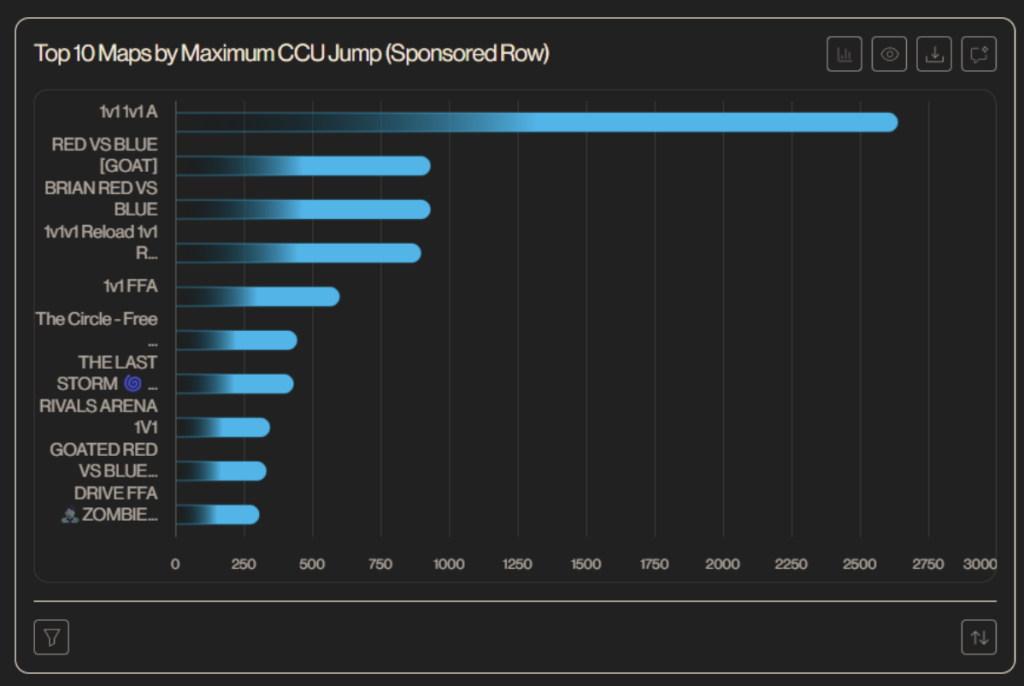
    First, a quick reality check: paying for placement isn’t a magic bullet. Over 97% of sponsored maps stay below the 500 concurrent user (CCU) threshold.  Only a slim 2.41% achieve top-tier numbers.

    However, when a map connects with the audience, the payoff is massive. 

    Competitive genres completely dominate here. Formats like “1v1” and “Red vs Blue” make up 60% of the top performers, proving these genres benefit the most from paid placement. One map, ‘1v1 1v1 A’, saw a dominant jump of 2,640 CCU! But don’t worry if you build niche modes; maps like Scrims or Zombies still saw a healthy, reliable baseline boost of 300 to 400 players, providing a great floor for discovery.

    The Organic “Halo Effect”

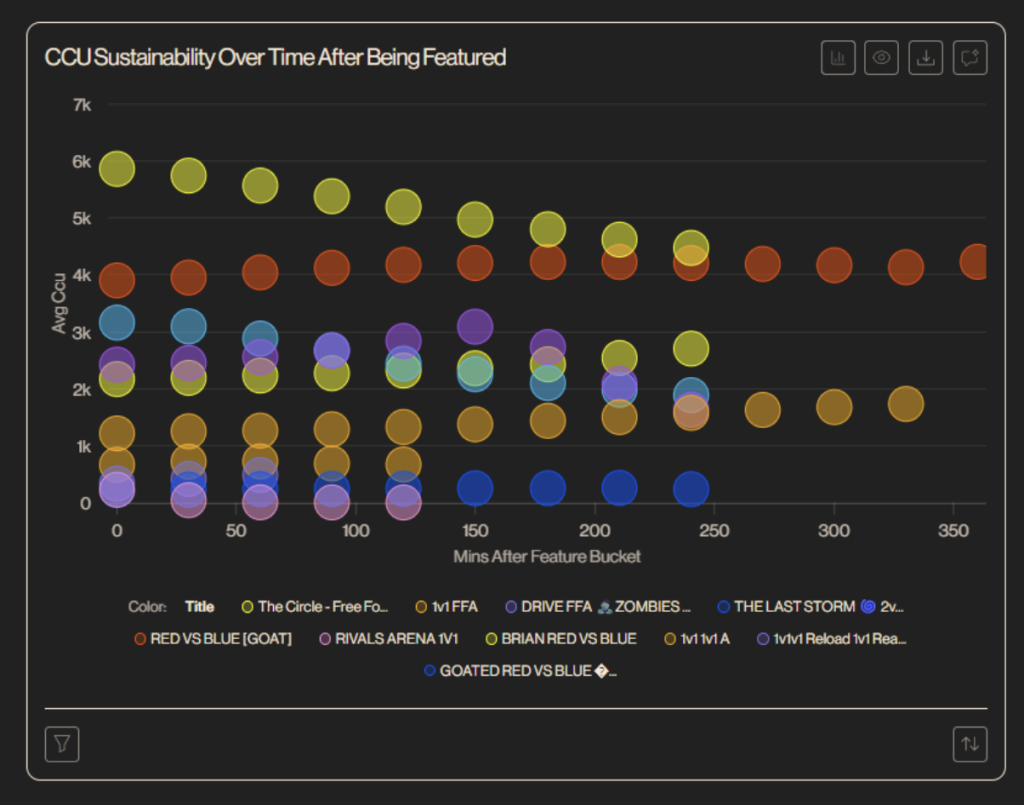
    The best part about the Sponsored Row isn’t just the paid traffic—it’s the organic snowball effect. Most maps with top ccu jumps sustain high engagement for a solid six hours (360 minutes) after being featured.

    User Query: How long did these maps sustain high ccu after being featured?

    If players stick around, the algorithm notices.

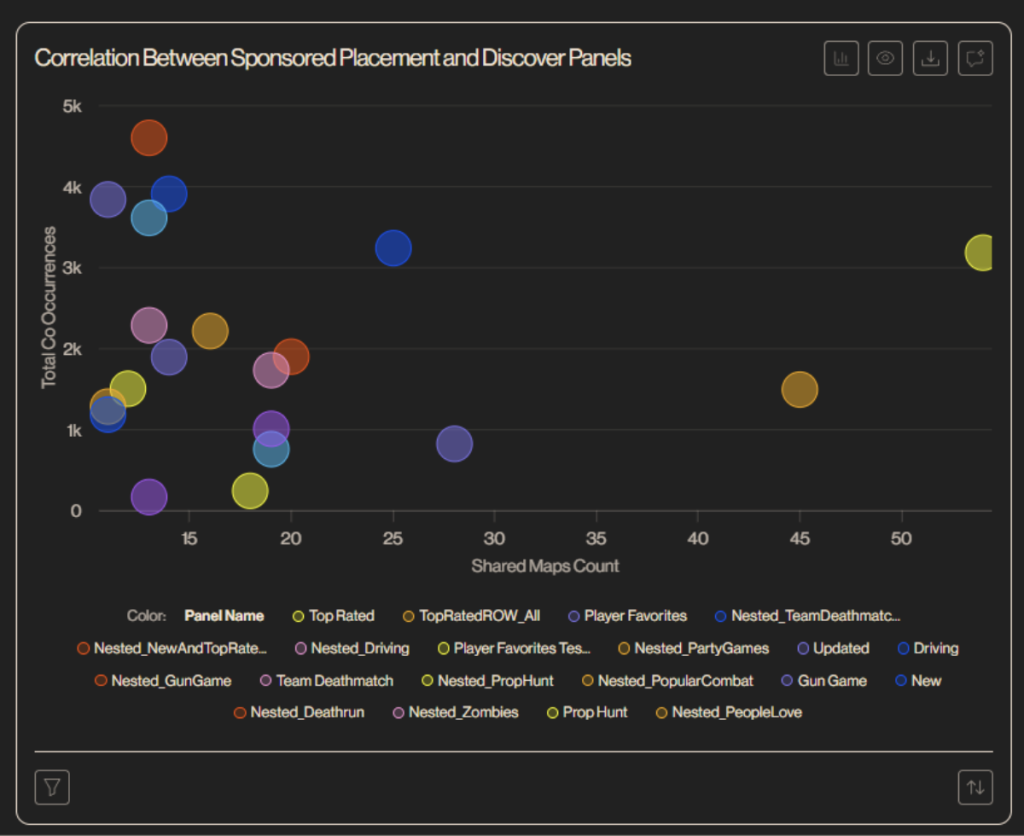
    User Query: Is there an algorithmic correlation between sponsored placement and other discover panels observable from the last week’s data?

    The data shows a strong correlation between sponsored placement and landing in panels like “Top Rated,” and “Player Favorites”. Genre specific panels such as “Team Deathmatch” and “Prop Hunt” also had high overlaps with the Sponsored row. 

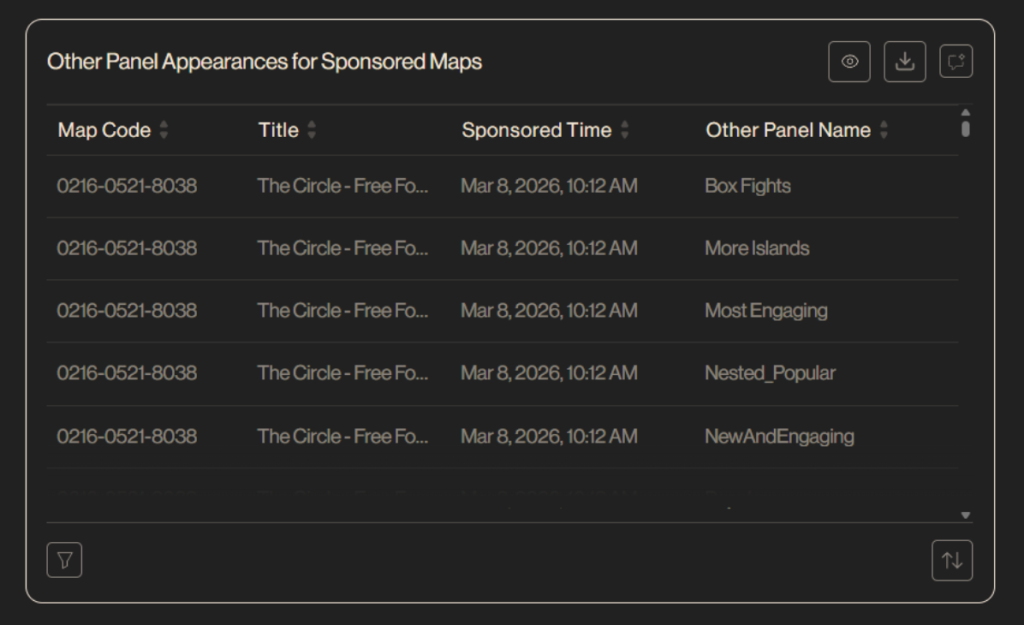
    User Query: Were these maps featured in any other discover or collections panels around the time they were featured in the sponsored panel?

    The map ‘The Circle – Free For All’ successfully maintained its presence across 7+ unique discovery rows on March 8 2026. In short: successful paid reach frequently converts into long-term organic reach.

    Timing is Everything

    If you are going to launch a campaign, timing is critical. 

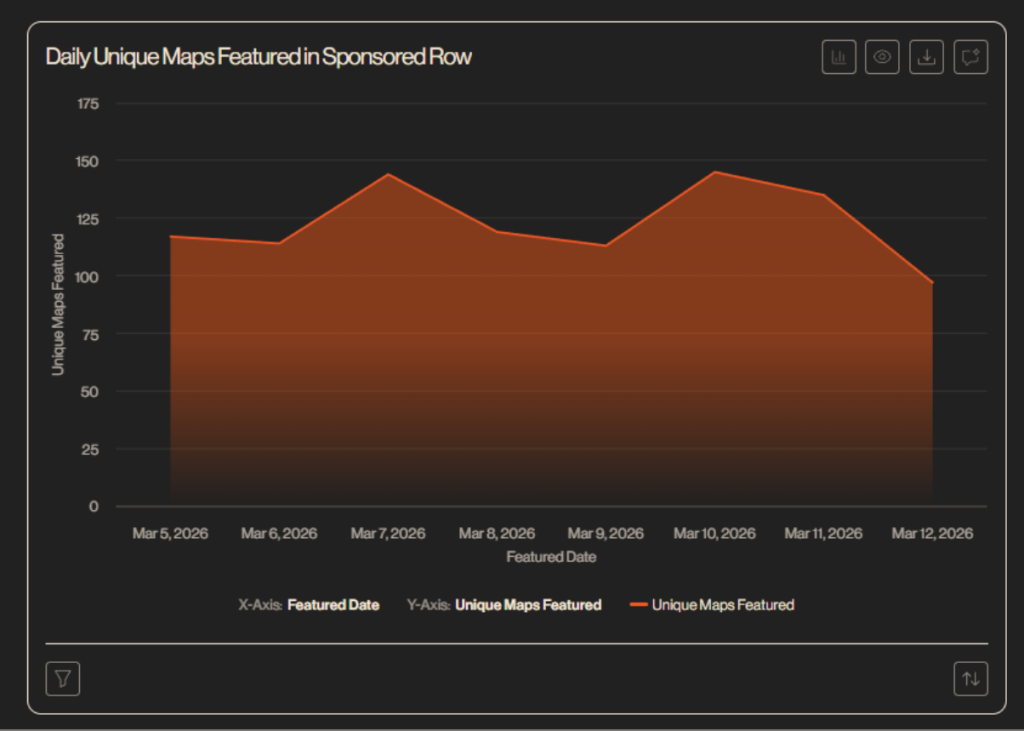
    User Query: How many unique maps were featured in the sponsored row on each day last week?

    We see high rotation during mid-week and weekends, peaking at around 144-145 unique maps per day.

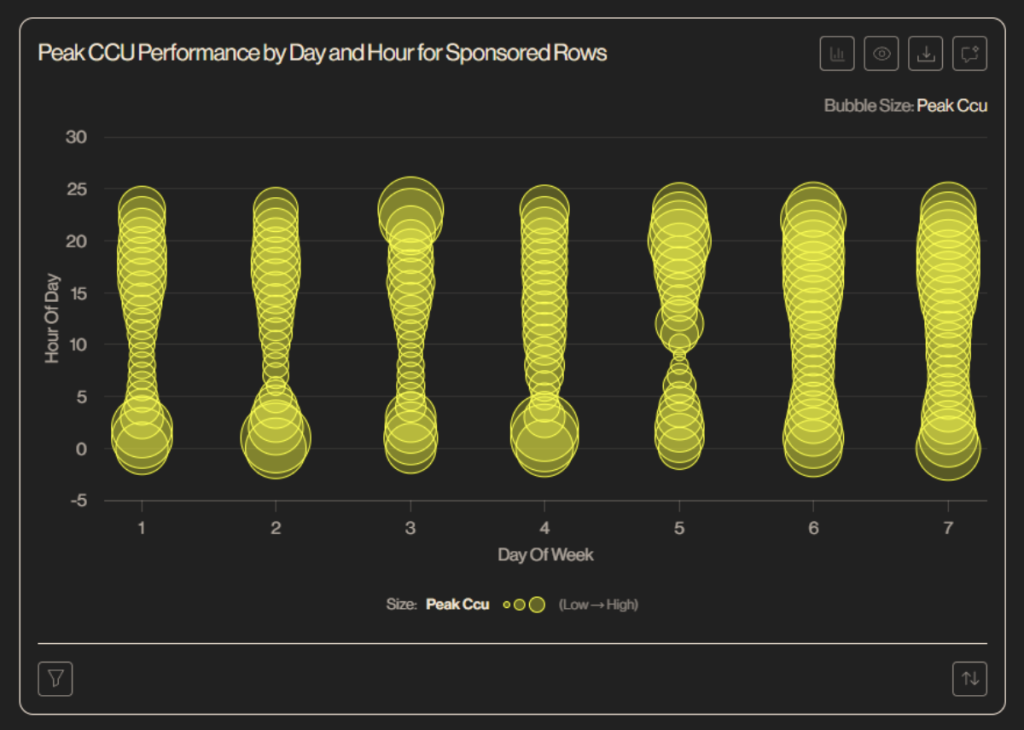
    User Query: What is the best day and time of the week to get featured in the sponsored row to achieve high ccu?

    If you’re chasing the absolute highest peak numbers, early week nights can be wild (Day 2, Tuesday, at 1:00 AM UTC hit an absolute peak of 16,542 CCU). But if you want sustained engagement—which is much better for the algorithm—Sunday is your golden ticket. Sunday holds the top three spots for highest average CCU between 5:00 PM UTC and 7:00 PM UTC. Friday nights at 10:00 PM UTC are also fantastic, reliably bringing in strong averages and peaks over 14,000.

    The Takeaway

    The Sponsored Row is an incredible amplifier, but it won’t fix a map that lacks retention. Build a highly engaging experience, target those weekend evening slots, and watch that paid visibility convert into lasting organic success!

    Want insights like this for your own map?

    Ask the Visceral AI chatbot anything. From retention benchmarks to Discover performance.
    Stop guessing and start optimizing with real Fortnite data.

  • Anatomy of a 50K CCU Fortnite Creative Map

    Anatomy of a 50K CCU Fortnite Creative Map

    Breaking 50,000 concurrent players in Fortnite Creative is rare. In our latest dataset, only three creator-made islands managed it.

    And they all have something in common.

    Brainrot.

    Every creator map crossing the 50K CCU threshold shares the same meme-native branding – suggesting that absurd internet culture may be doing some heavy lifting in Fortnite discovery.

    The Giant Outlier

    One island completely dominates the leaderboard.

    STEAL THE BRAINROT hit a peak of 1,083,892 concurrent players, accounting for over 85% of the combined peak CCU among the top three islands.

    That’s not a small lead. That’s a planet-sized lead.

    Fortnite Creative, like most creator economies, follows a familiar pattern:
    a few massive hits capture the majority of players.

    Retention Wins Games

    What’s even more interesting is that the biggest map is also the stickiest.

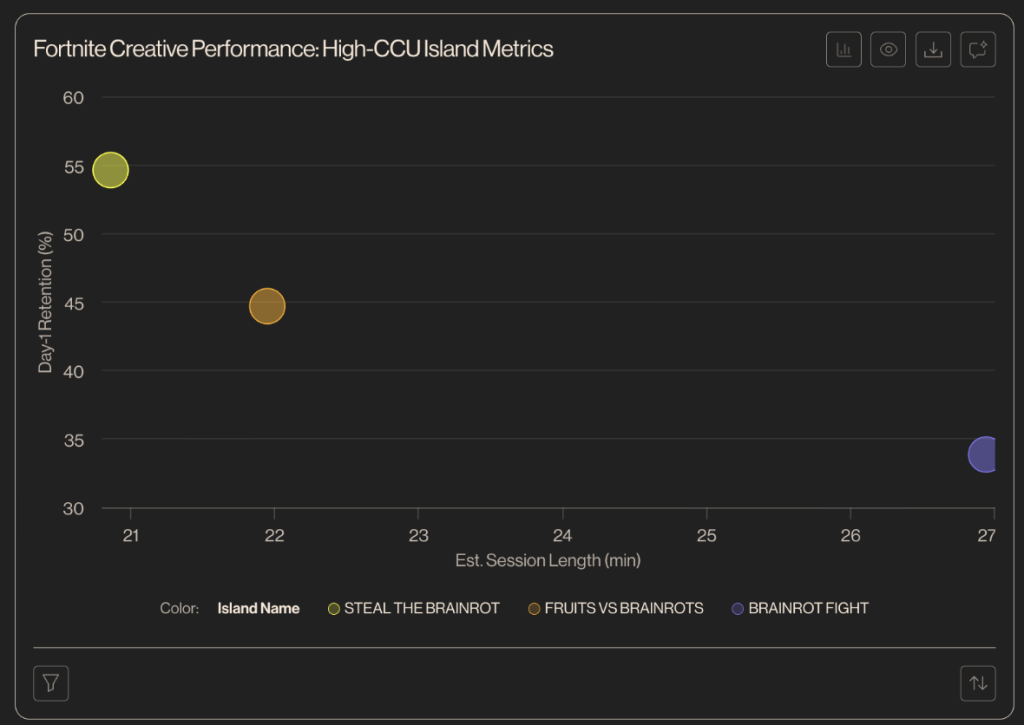
    STEAL THE BRAINROT holds a massive 54.63% Day-1 retention, meaning more than half of players come back the next day.

    Across the top islands:

    • Average session length: ~23 minutes
    • Peak retention: 54.63%

    In short: players aren’t just clicking – they’re staying.

    Different Ways to Win

    Not every map wins the same way.

    While STEAL THE BRAINROT dominates on scale, BRAINROT FIGHT actually has the longest sessions, averaging nearly 27 minutes per player.

    That suggests two different success models in Creative:

    Viral maps

    • massive player spikes
    • social spread
    • big Discover momentum

    Engagement maps

    • smaller audiences
    • longer sessions
    • deeper gameplay loops

    Both can work. They just optimize for different player behaviors.

    The Takeaway

    If there’s a lesson here, it’s this:

    • Memes get players in the door.
    • Retention keeps them there.

    Fortnite Creative might look chaotic from the outside, but underneath the memes and madness, the data tells a clear story:

    The maps that win are the ones players come back to.

    Want insights like this for your own map?

    Ask the Visceral AI chatbot anything. From retention benchmarks to Discover performance.
    Stop guessing and start optimizing with real Fortnite data.
  • The State of Fortnite Creative: What the Data Says About the Ecosystem in Q1 2026

    The State of Fortnite Creative: What the Data Says About the Ecosystem in Q1 2026

    Fortnite Creative has evolved into a massive creator economy, but the distribution of success inside the ecosystem is far from equal.
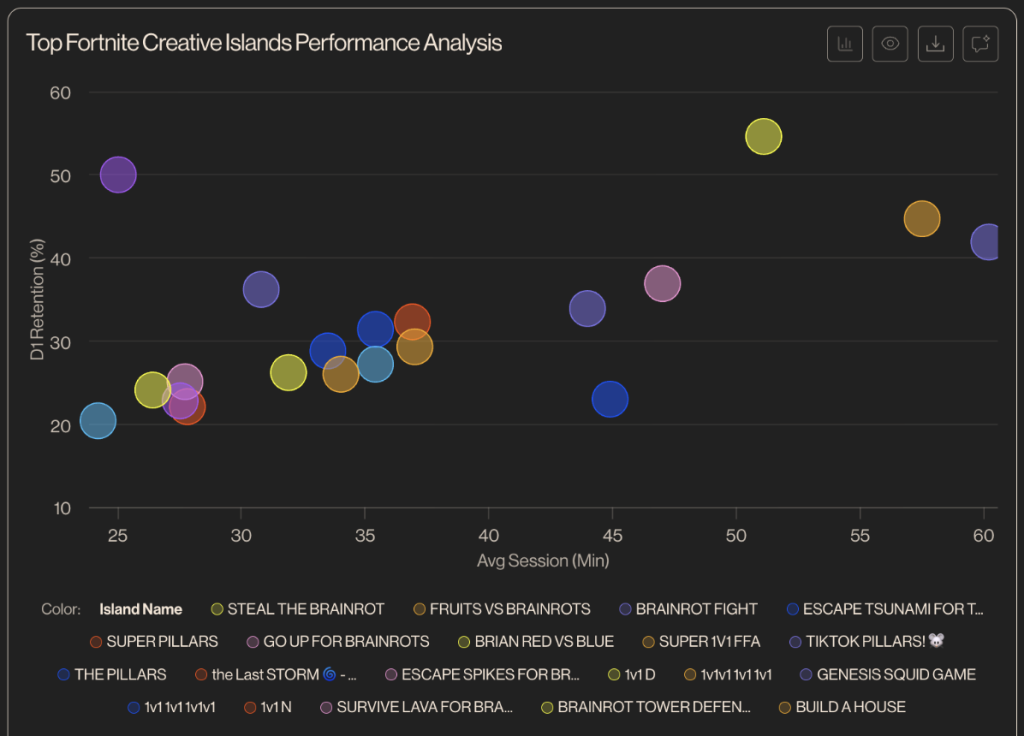
    Using Visceral.io ecosystem data across top-performing creator-made islands, a clear pattern emerges: a handful of breakout experiences capture the majority of player attention, while the rest of the market competes in a long tail of smaller audiences.

    Enter Prompt: “What are the top Fortnite Creative maps in the last 3 months based on D1 Retention and Average Session time”

    A Hit-Driven Economy

    The most striking signal in the data is how concentrated player traffic is. One island – STEAL THE BRAINROT – reached a peak of 1,083,892 concurrent players, capturing significantly more traffic than the rest of the top Creative islands combined.

    This reflects a classic power-law distribution seen across creator platforms like YouTube, Roblox, and Steam. A small number of hits dominate attention, while thousands of smaller experiences compete for discovery. For creators, this means the difference between a good map and a breakout hit is enormous.

    Retention Drives Success

    If peak CCU shows acquisition power, retention reveals the real engine behind successful islands. Two of the strongest performers in the dataset – STEAL THE BRAINROT and SUPER 1V1 FFA – both achieve over 50% Day-1 retention, meaning more than half of players return the following day.

    Across the top Creative islands:
    Average session length: 36.9 minutes
    Mean peak CCU: 78,980 players

    These numbers highlight an important pattern: maps that keep players engaged for longer sessions tend to generate stronger repeat play and sustained traffic.

    The Rise of Simulator and Tycoon Formats

    When we look at genres driving the strongest engagement metrics, Simulator and Tycoon maps stand out clearly.

    These progression-driven experiences are producing:

    • Peak CCU in the tens or hundreds of thousands
    • Average session lengths exceeding 45 minutes

    Unlike traditional PvP formats, these maps rely on progression loops, upgrades, and resource accumulation, creating longer play sessions and stronger player investment.
    This structure mirrors the mechanics that have long powered Roblox’s most successful games.

    Competitive Maps Follow a Different Pattern

    Not every successful island relies on long progression loops. Low barrier competitive formats, especially 1v1 and free-for-all maps, behave differently.

    Maps like SUPER 1V1 FFA generate:

    • Shorter sessions
    • High replay frequency
    • Extremely strong Day-1 retention

    Rather than holding players for long sessions, these maps succeed by encouraging quick repeat matches and habitual play.
    In other words, Creative is now supporting two different engagement models:

    1. Progression Worlds – Long sessions, Tycoon / simulator loops, Deep player investment
    2. Competitive Arenas – Short sessions, Fast match cycles, High replay frequency

    Both formats can succeed but they rely on very different player behaviours.

    What This Means for Creators

    The data suggests three clear signals for builders in the Fortnite ecosystem:

    1. Hits dominate the market
      The majority of player traffic concentrates around a small number of breakout islands.
    2. Retention matters more than novelty
      Experiences that bring players back the next day consistently outperform those that rely purely on initial discovery spikes.
    3. Progression systems are driving engagement
      Simulator and tycoon mechanics are currently the strongest structure for sustaining long play sessions.

    Fortnite Creative is no longer just a collection of minigames. It’s evolving into a full creator economy where retention systems, progression loops, and player psychology increasingly determine which experiences break out.
    And as the ecosystem continues to grow, understanding the data behind those patterns will only become more important for creators hoping to build the next breakout island.

    Want insights like this for your own map?

    Ask the Visceral AI chatbot anything. From retention benchmarks to Discover performance.
    Stop guessing and start optimizing with real Fortnite data.